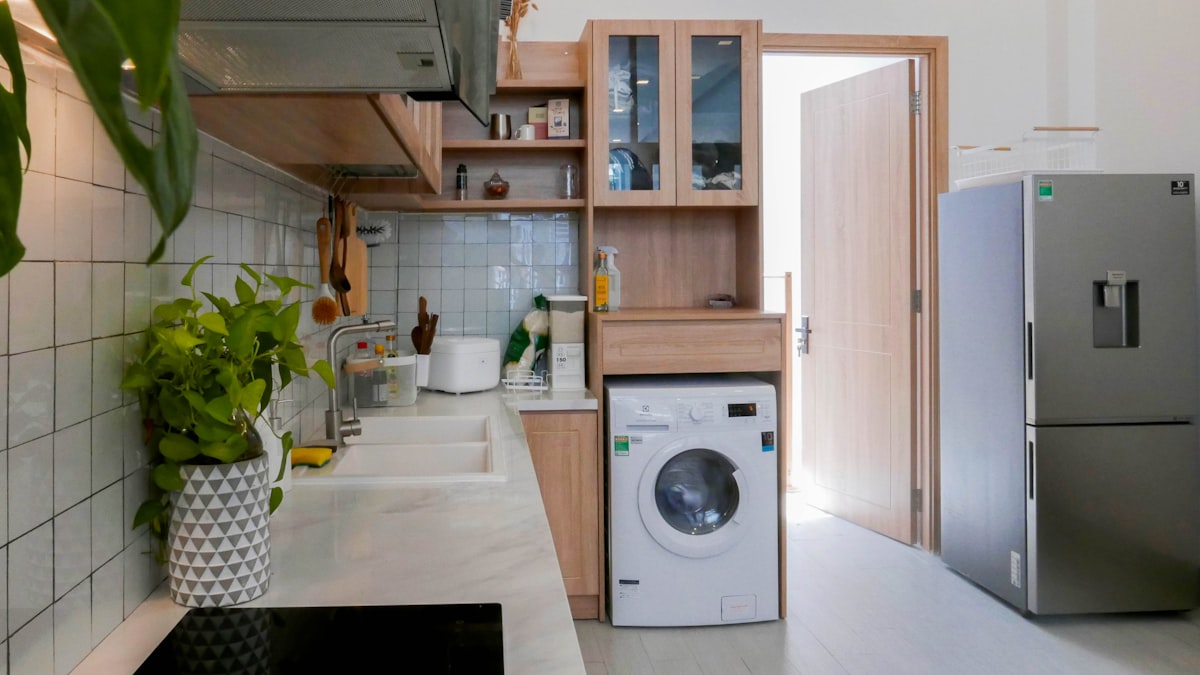
TL;DR: Front-load washers typically use 30–50% less water per cycle than traditional agitator top-load machines, and their faster spin speeds cut dryer energy use too. High-efficiency (HE) top-load models without an agitator close most of that gap, cost less upfront, and skip the mold-prone rubber door gasket.
How Front-Load and Top-Load Washers Actually Clean Differently
The efficiency gap between washer types comes down to one mechanical fact: how each machine gets clothes moving through water.
A traditional top-load washer uses a center post — the agitator — that twists back and forth, dragging fabric through the water around it. For that to work, the tub has to be filled high enough to fully submerge the load, which is the single biggest reason older top-load machines use so much water.
A front-load washer skips the agitator entirely. The drum sits horizontally and simply tumbles the load through a shallow pool of water at the bottom, using gravity instead of a paddle to do the mechanical work. Less water is needed because clothes don't need to be fully submerged — they fall through the water repeatedly as the drum spins.
A newer category, the high-efficiency (HE) top-load washer, splits the difference: no center post, just a low-profile plate or impeller at the bottom of a top-loading tub. It uses noticeably less water than an old-style agitator machine, though usually still a bit more than a front-load.
The Water Numbers, Compared
Exact figures vary by model and load size, but the pattern is consistent across the industry and shows up in the Integrated Water Factor (IWF) — gallons of water per cubic foot of drum capacity per cycle — that manufacturers report for ENERGY STAR certification:
| Washer Type | Typical Water Per Load | Typical Spin Speed |
|---|---|---|
| Older agitator top-load (non-HE) | 30–45 gallons | 650–800 RPM |
| HE top-load (impeller, no agitator) | 15–22 gallons | 700–1,000 RPM |
| Front-load | 13–20 gallons | 1,200–1,600 RPM |
That spin-speed column matters more than most buyers realize. A front-load washer's faster spin extracts significantly more water from clothes before they ever reach the dryer — which means less time and less electricity spent evaporating water out of wet fabric. Since the dryer is often the single biggest energy draw in a household's laundry routine, that extraction difference compounds the water savings into an energy savings too.
What an ENERGY STAR Rating Actually Measures
ENERGY STAR certification for clothes washers isn't a marketing badge — it's based on two measured values: the Integrated Water Factor (IWF) and the Integrated Modified Energy Factor (IMEF), both of which account for water heating energy, motor energy, and dryer-side moisture retention. As a general rule, ENERGY STAR–certified washers use meaningfully less water and energy than standard, non-certified models — roughly a third less water and about a quarter less energy is the range ENERGY STAR itself typically cites for certified vs. non-certified machines.
The practical takeaway: the ENERGY STAR label matters more than the top-load/front-load label. A certified HE top-load washer will usually beat an old, non-certified front-load machine — efficiency has improved across both categories over the past decade, and the agitator (or lack of one) is only part of the story.
Where Top-Load Machines Actually Win
None of this makes front-load washers the obvious pick for every household. They have real, well-documented downsides:
- Odor and mold risk: the rubber door gasket on a front-load machine traps moisture. Leaving the door closed right after a cycle is the single most common cause of the musty smell front-load owners complain about. It's manageable — leave the door cracked open between loads and run an empty hot-water cycle monthly — but it's a real maintenance habit top-load owners don't need.
- Upfront cost: front-load washers typically run $700–$1,600, versus $450–$900 for an agitator top-load and $600–$1,200 for an HE top-load. The energy and water savings take years to offset that gap.
- Repair cost: door seals, bearings, and the counterbalance system on front-load drums are more expensive to service than a top-load's simpler mechanicals.
- Cycle time: front-load cycles commonly run 60–90 minutes versus 30–45 for top-load, since the tumbling wash action is gentler and slower than an agitator.
- Ergonomics: loading and unloading a front-load machine means bending down, which is a genuine accessibility issue for some households; top-load requires no bending and lets you add a forgotten sock mid-cycle.
So Which Should You Actually Buy?
If minimizing water and energy use is the priority and you can tolerate the gasket-maintenance habit, a front-load washer is the more efficient machine, full stop — the water and spin-speed numbers are not close. If you want most of that efficiency without the door-seal maintenance, the higher upfront cost, or the longer cycles, an ENERGY STAR–certified HE top-load model is a legitimately good middle path, not a compromise pick. What you should actively avoid, from a resource-use standpoint, is a non-HE agitator top-load washer — those are the machines actually driving the "top-load wastes water" reputation, and newer HE top-load designs have mostly fixed the problem the stereotype is based on.
Whichever machine you choose, two habits move the needle more than the appliance itself: washing full loads instead of small ones (water use per garment drops sharply as load size increases), and defaulting to a cold-water cycle, since roughly 90% of a washer's energy use in a hot-water cycle goes to heating the water, not running the motor.
The Lifetime Cost Question
Sticker price tells an incomplete story. Over a machine's typical 10–12 year lifespan, the water and electricity bill differences between washer types add up to real money — often enough to close most or all of the upfront price gap. A household running five loads a week on hot water will spend noticeably more over a decade on a non-HE agitator machine than on a comparably priced ENERGY STAR front-load or HE top-load unit, once water heating costs are factored in. That's before counting the dryer-side savings from a front-load's faster water extraction, which shortens every single dry cycle that follows.
Repair costs cut the other way. Front-load bearings and door seals are more expensive parts to replace than an agitator top-load's simpler drivetrain, and a failed bearing on an older front-load machine can cost enough in labor that replacement becomes more economical than repair. Factor a rough repair-cost cushion into the math if you're comparing a front-load washer against a top-load model rated for a similarly long service life.


Reviews & Comments
Loading...