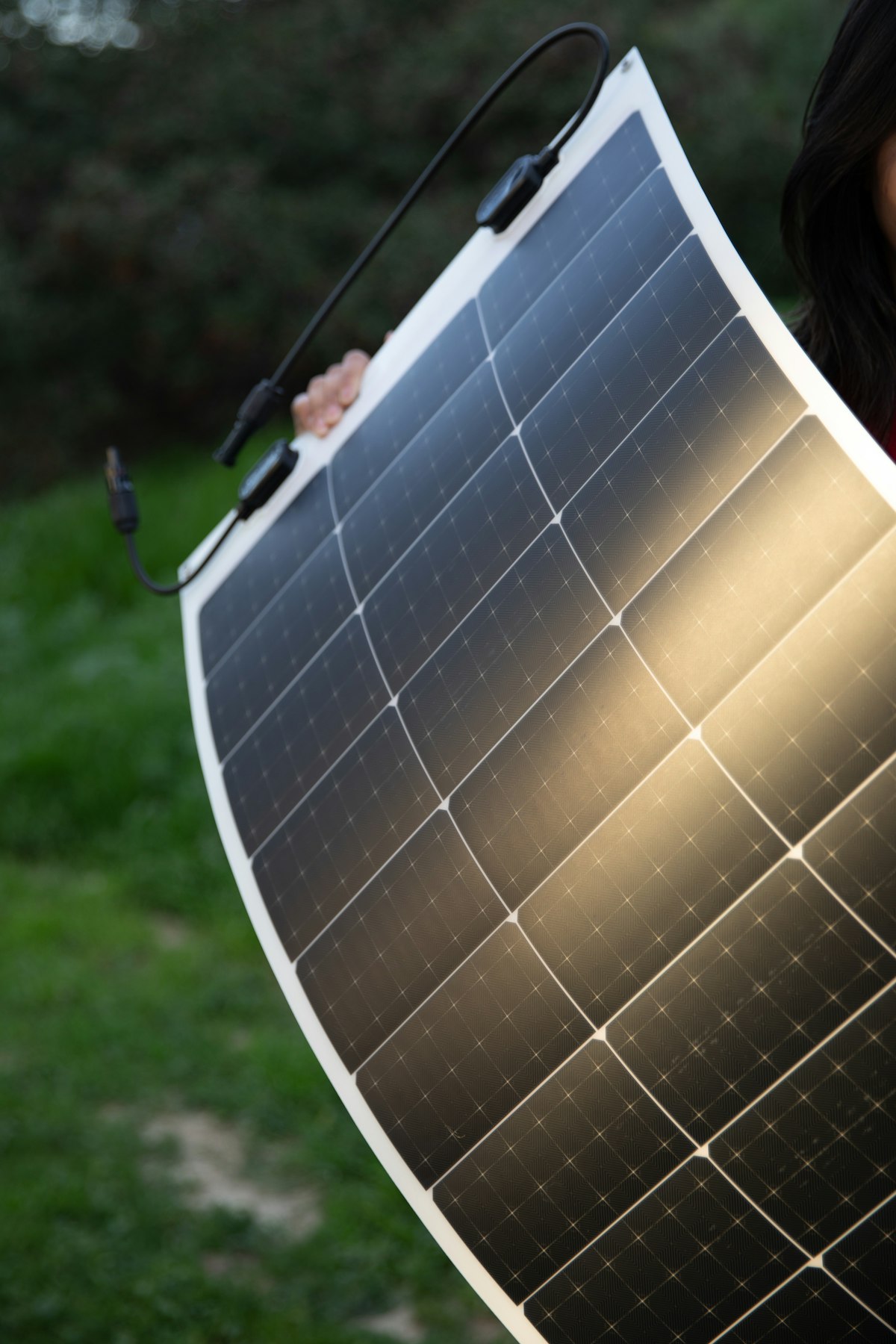
TL;DR: The math doesn't favor them — a phone-case-sized solar panel produces roughly 1–1.5 watts in direct sun, compared to the 10–20W a phone actually draws from a wall charger, so even hours of full sun exposure add only a modest trickle of charge. Treat solar phone cases as an emergency backup, not a charging solution.
The Physics: Why Panel Size Is the Limiting Factor
Solar panel output scales with panel area, sunlight intensity, and cell efficiency — and a phone case fails on the first variable badly enough that the other two barely matter. Full outdoor sunlight at solar noon under a clear sky delivers roughly 1,000 watts per square meter, or about 100 milliwatts per square centimeter. The compact, flexible thin-film solar cells used in gadget-sized products typically run somewhere around 15–20% efficiency, well below the 20%+ efficiency of rigid panels used on rooftops.
The usable back surface of a phone case, once you subtract the camera cutout, branding, and curved edges, is roughly 70–90 square centimeters. Run the numbers on the generous end: 85 cm² × 0.10 W/cm² × 18% efficiency comes out to about 1.5 watts — and that's the absolute best case, with the panel perfectly perpendicular to direct, unobstructed sunlight. Any cloud cover, indirect angle, or the phone sitting in a pocket or bag (which is where phones spend most of the day) drops that further, often close to zero.
Compare that to what a phone actually needs. A modern smartphone battery holds roughly 10–15 watt-hours, and a standard 10–20W wall charger fills that from empty in something like 1–2 hours. A 1–1.5W trickle would need something like 7–10+ hours of uninterrupted, perfectly angled direct sunlight to deliver a comparable amount of energy — essentially a full workday of leaving your phone face-up outdoors, which isn't how anyone actually uses a phone.
What Real-World Use Actually Shows
The pattern reported consistently by people who've actually tried solar phone cases and small solar phone chargers under bright, direct, unobstructed sun for several hours: a modest percentage of added charge — commonly in the ballpark of 5–15% over a few hours of genuinely good conditions — not a meaningful top-up, and closer to nothing at all on a cloudy day or with the phone in a bag. That tracks with the physics above; there's no real-world trick that gets around a panel this small producing this little power.
There's also a downside specific to the always-attached form factor: if the case has its own internal battery pack (many solar cases do, storing the trickle for later rather than feeding the phone directly), that pack sits against the phone and absorbs the phone's own operating heat plus direct sun exposure. Heat is a well-established accelerant of lithium-ion battery degradation, so a solar case worn daily in sunlight can shorten the life of both batteries involved faster than a normal case would.
What Actually Works Instead
Standalone folding solar panels — from brands like Anker, BigBlue, and Goal Zero — offer roughly 10–20 times more usable surface area than a phone case, with unfolded panels commonly rated in the 20–100+ watt range under full sun when paired with a battery pack. That's a genuinely useful amount of power for backpacking, camping, or emergency preparedness, but it's a separate accessory you carry and deploy, not something built into your everyday phone case.
For daily use, a simple battery power bank charged at home from a wall outlet is dramatically more energy- and cost-effective per charge cycle than embedding a tiny solar cell in a case you carry around all day. Where a solar phone case can legitimately earn its place is a genuine multi-day, off-grid situation — hiking, an emergency kit, disaster preparedness — where any trickle of charge beats a completely dead phone and there's no other power source available. As a backup of last resort, the physics still apply, but "something is better than nothing" changes the calculation. As a primary charging method for normal daily use, it doesn't hold up.
How to Read Solar Phone Case Marketing Claims
Product listings for solar phone cases rarely state wattage plainly, and that's worth noticing on its own — a genuinely useful power source usually leads with its output number. Instead, look for language like "extends battery life" or "backup solar charging," which are true in the narrowest possible sense (some trickle is better than none) while sidestepping how small that trickle actually is. A few checks before buying one:
- Look for an actual wattage or mAh-per-hour-of-sun figure. If a listing won't state one, assume it's because the number wouldn't help the sales pitch.
- Check whether it has its own battery or charges the phone directly. A case with an internal battery pack at least stores the trickle for later use instead of losing it when the phone is briefly shaded, but it adds the heat-exposure downside discussed above.
- Compare the price to a basic power bank. Many solar phone cases cost as much as or more than a 10,000mAh battery pack that would charge a phone fully two to three times over from a five-minute wall-outlet plug-in at home — for a fraction of the hassle and a fraction of the wait.
None of this means solar charging technology is fake or useless — it means the physics of a phone-case-sized panel specifically don't add up to meaningful daily charging, regardless of how the product is marketed.
Reviews & Comments
Loading...